
We can often give good reasons like “that Oura ring helps me stay healthy,” “I like the creaminess of Nespresso” or “I fell for the stylish design and convenience”… But rather than fulfilling rational or emotional needs many objects primarily satiate a sociological desire: The desire to be like people we associate with those objects.
Thus, the kitchen or an Oura ring on our finger is as likely driven by the want to channel the suave connoisseur we imagine George Clooney to be or to be part of the tribe who seems to bio-hack their way to a perfectly balanced life of wealth and wellness… and eternally youthful Jennifer-Aniston-looks.
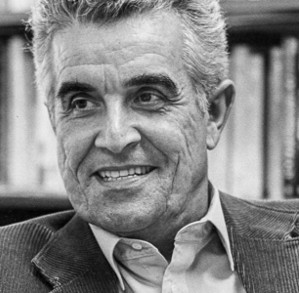
René Girard (1923–2015) philosopher of social science
French philosopher René Girard posited that the desirable attribute of a product is not what it does, but who the consumer is trying to become by owning it. And people only know what they want to become by looking at others and mimicking their desires as expressed in what they say, own or do.
As Girard explains in ‘Deceit, Desire, and the Novel’ (1961), “we would like our desires to come from our deepest selves, […] but if it did, it would not be desire. Desire is always for something we feel we lack.” He called this strange desire-to-desire-what-others-desire “mimetic desire”.
By now, marketers – particularly those working in the Lifestyle and Luxury industry – will smell the opportunity to build deeply rooted desire into their brands. If you can make your brand be perceived as desired by people that a larger group of potential customers wants to mimic, then you are on track to create a magnetic icon of a brand. We call the first group the ‘Design-Target’ and the latter the ‘Strategic Target Segments’. – Take a look at my nifty graphic for clarification.
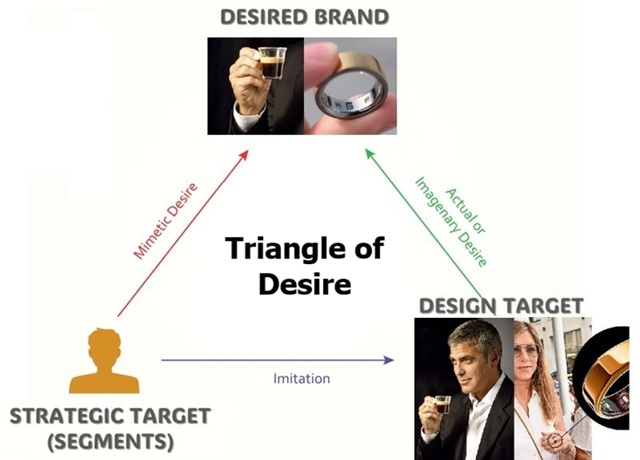
Mimetic Desire (after R. Girard)
Now, an important variable in this is the degree to which the Strategic Target feels that the Ueber-Target lives a desired life AND truly desires that branded product: The Kelly bag became an icon because a real-life Cinderella (Princess Grace of Monaco) seemed to truly love her Hermès bag. With George, most of us sense that he gets paid handsomely by Nespresso – but we credit that he seems to have fun with it and truly enjoy the brew. Leveraging ‘Social Media Influencers’ becomes riskier for a brand, though. Rather than admiring them from afar, we might perceive those ‘bio-hacking hustlers’ as peers and rivals for a desired life state. ‘Desire’ might turn into ‘envy’ or even rejection because we do not want to be like “them” (maybe because we fear we can not…).
Next time you say, think or feel “I want that,” think again. Is it really “that” or … “to be like these people’? And is “that” the object or rather the ‘Dream’ the brand manifests?
But wait, there is more…
 For deeper insights into what drives the success of ‘Ueber-Brands’** and for many, in-depth case studies illustrating those drivers, read our book “Rethinking Prestige Branding – Secrets of the Ueberbrands.”
“Brand Elevation – Lessons in Ueber-Branding” is our practical guide to help you give a brand meaning and making it peerless and priceless. It features many application examples as well as case studies shared first-hand by marketing leaders from brands as diverse as Airbnb, Acqua Di Parma, Starbucks, TerraCycle or Youtube.
Take some inspiration from our collection of case studies that illustrate how to manifest a brand through its product and services
* ‘ueber’ = German for ‘above and beyond’ – just like the ambitions of brands we are talking about.
Want us to help you elevate your own brand? Write to us at info@ueberbrands.com


 Ueber-Brands™